
Key Takeaways:
- Finding a single mouse in your home is rarely an isolated incident, as their social nature and biology strongly suggest a larger hidden family structure nearby. Spotting a mouse during daylight hours is a major red flag that indicates a severe, overcrowded infestation rather than a simple lost wanderer.
- The physical evidence mice leave behind, from the specific frequency of droppings to the presence of multiple generations, reveals critical secrets about the size and maturity of the colony beneath your roof.
- A single breeding pair can spark a catastrophic population explosion of dozens of rodents in just a few months due to their rapid reproductive cycle and brief gestation periods.
- Standard retail traps often fail to solve the root problem, leaving the smartest and most active members of the colony to continue breeding in your walls.
Does One Mouse Mean There Are More Mice?
Finding a mouse in your kitchen or hearing a faint scratching in the walls can send a chill down any homeowner’s spine. Your immediate reaction is probably a mix of disgust and a pressing question: Is this just this mouse, or am I dealing with a full-blown rodent infestation?
While you can keep your fingers crossed it’s just one mouse, the odds are against this being the case. The hard truth of rodent biology says that if you’ve spotted a mouse in your Northeast Georgia-area home, there are probably more. Here is what is actually happening behind your drywall — and why you probably need to act quickly.

Leave your information below and we’ll be in touch shortly. After hours calls will be returned the next business day.
Does One Mouse Mean There Are Many More Lurking?
While it is technically possible for a single, adventurous field mouse to wander through an open door, it is improbable. Mice are social creatures that live in family structures. Where there is one, there is almost always a nest nearby.
Furthermore, how and when you saw the mouse is also important, as it can tell you how severe the problem actually is. Let’s run through some common urban myths about mice in homes and lay the facts on the table.
Fact or Fiction: “Seeing a mouse during the day means there’s probably just one mouse.”
Mice are strictly nocturnal. If you see a mouse braving the daylight in an active part of your home, it does not mean it just got lost. It usually means the local nest is so overcrowded that lower-ranking mice are being forced to forage during the day, or their nest has been disturbed. A daytime sighting is a red flag for a heavy infestation, not a lone wanderer.
The Reality: Fiction.
At American Pest Control, Inc., we’re always ready to help you with your pest control needs. Contact us for a free, no obligation quote, or call us at (706) 546-1490 to get started today.
Leave your information below and we’ll be in touch shortly. After hours calls will be returned the next business day.
Fact or Fiction: “A few droppings means a small problem.”
Some say that if you only see five or six droppings, you’re probably only dealing with a single mouse. In fact, the number of droppings you see has nothing to do with how many mice are present. A single mouse produces between 40 and 100 droppings on its own every single day.
If you only find 5 or 6 droppings on a counter, you haven’t found the extent of the problem — you’ve simply found a spot where a mouse paused for a few minutes.
The Reality: Fiction.
Fact or Fiction: “Hearing scratching in multiple rooms means you have a massive infestation.”
Hearing scurrying in the living room ceiling and then hearing it an hour later in the kitchen pantry can make it feel like your house is crawling with dozens of rodents. In reality, mice are incredibly fast, highly active, and use hidden structural “highways” (like pipe runs and HVAC ducts) to travel across an entire house in seconds.
Hearing noises everywhere can mean a huge infestation, but it can also just be two or three highly active mice mapping out your home’s infrastructure.
The Reality: Inconclusive.
Fact or Fiction: “If you find small mice and large mice together, you are dealing with multiple generations.”
If you spot a tiny juvenile mouse alongside a larger adult, it is a sign that a female has successfully nested and given birth inside your home. Because mice reach breeding maturity in under two months, seeing multiple sizes of rodents means you are no longer dealing with a few random invaders — you are officially dealing with a multi-generational colony that is actively multiplying right under your roof.
The Reality: Fact.
Why One Mouse Quickly Turns Into Dozens
Ignoring a single mouse sighting is a recipe for a household disaster. As we’ve established, the presence of one rodent often means many more, and multiple rodents means they’re likely reproducing. Once they’re reproducing, it’s difficult to stop them because rodents reproduce at an alarmingly fast rate.
- Rapid Maturity: A female mouse reaches reproductive maturity in just 5 to 8 weeks.
- Non-Stop Breeding: Gestation takes only about 21 days. A single female can produce up to 10 litters a year.
- Massive Litters: With an average of 6 to 8 pups per litter, a single breeding pair can easily trigger a population explosion of dozens of mice within just a couple of months.
Clear Signs of a Hidden Mouse Nest
Because house mice are highly skilled at avoiding detection, you have to look for the evidence they leave behind. Keep an eye out for these classic signs of a rodent infestation:
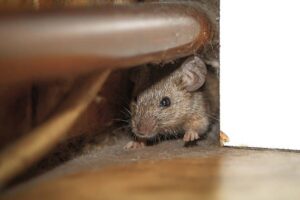
- Hidden Noises: Scratching, scurrying, or faint squeaking inside your walls, ceilings, ductwork, or crawlspaces—especially after dark.
- Damage and Gnaw Marks: Mice have teeth that never stop growing, meaning they must constantly chew. Look for gnaw marks on baseboards, cabinets, plastic packaging, and dangerous chewing on electrical wiring.
- Pungent Odors: A distinct, stale, ammonia-like smell caused by mouse urine, which becomes highly noticeable near nesting sites or heavy traffic areas.
- Runways and Entry Holes: Small, dime-sized holes chewed through drywall or the backs of cabinets, often accompanied by dark smudge marks (rub marks from the oils in their fur) along the baseboards.
- Nesting Material: Piles of shredded paper, cardboard, fiberglass insulation, or fabric tucked away in dark, undisturbed corners like the back of your pantry or under appliances.
Where Do Mice Like to Hide?
If you’ve seen one mouse, grab a flashlight and check these primary rodent real estate spots in your home:
- The Kitchen Triad: Behind the refrigerator, underneath the stove, and deep in the back corners of your pantry cabinets.
- Utility Access Points: The gaps around the plumbing pipes under your kitchen and bathroom sinks, and behind your washing machine.
- Warmth Sources: Behind or inside the insulation of your water heater and HVAC units.
What Should You Do If You Catch One Mouse?
The best course of action after finding a single mouse is to call a rodent control expert to come take a look. They will be able to determine exactly how extensive the infestation is and put a permanent stop to it.
However, we understand that many homeowners like to try to solve the problem on their own before calling a professional. If you want to do it that way, don’t just set out a mousetrap and assume it will solve everything. You should assume there are many more mice and create a comprehensive plan.
- Deprive Them of Food: Move all boxed pantry items (cereals, crackers, pet food) into airtight plastic or glass containers. Wipe down counters to ensure there are no crumbs.
- Eliminate Water Sources: Fix leaky faucets and wipe out wet sinks before bed. Mice need water, and an open sink is an oasis.
- Keep Your Distance: If you catch a mouse in a DIY trap, wear gloves and a mask when disposing of it. Spray the area with a disinfectant—never sweep or vacuum dry mouse droppings, as this can aerosolize dangerous pathogens.
- Call the Professionals: The longer the problem goes on, the bigger your risk becomes. If your mousetrap isn’t working and you keep seeing signs of mice around the home, you should call a rodent exterminator as soon as possible.
Protect Your Home: Call the Experts at American Pest Control, Inc.
Mice are more than just a nuisance; they carry dangerous pathogens, ruin food supplies, and pose a legitimate fire hazard when they chew through wiring. Standard retail traps rarely solve the root of the problem because they only catch the mice careless enough to get caught—leaving the rest of the colony to keep breeding.
At American Pest Control, Inc., we take a comprehensive approach to rodent control in Athens, GA. Our certified technicians don’t just set traps; we perform a deep-dive inspection to locate the nests, identify their hidden entry points, and implement professional exclusion tactics to keep them out for good.
Don’t wait for one mouse to become dozens. Contact American Pest Control, Inc. today to schedule your comprehensive inspection and get a free, no-obligation estimate.